Cost Caps can be an incredibly powerful way to scale your Meta ad account.
They’re elastic, flexible, and designed to be cost-constrained so that you can capture periods of big demand (like Sunday evenings) without blowing out your budget on every other day of the week like you could if you were constantly adjusting highest volume campaign budgets.
But setting them up can feel confusing. They’re risky if you do it wrong and if you’re not careful you can burn A LOT of ad spend for not a lot of revenue really fast.
Follow this comprehensive guide to Cost Cap campaigns on Meta for help starting your own Cost Cap campaigns.
What Is A Cost Cap Campaign?
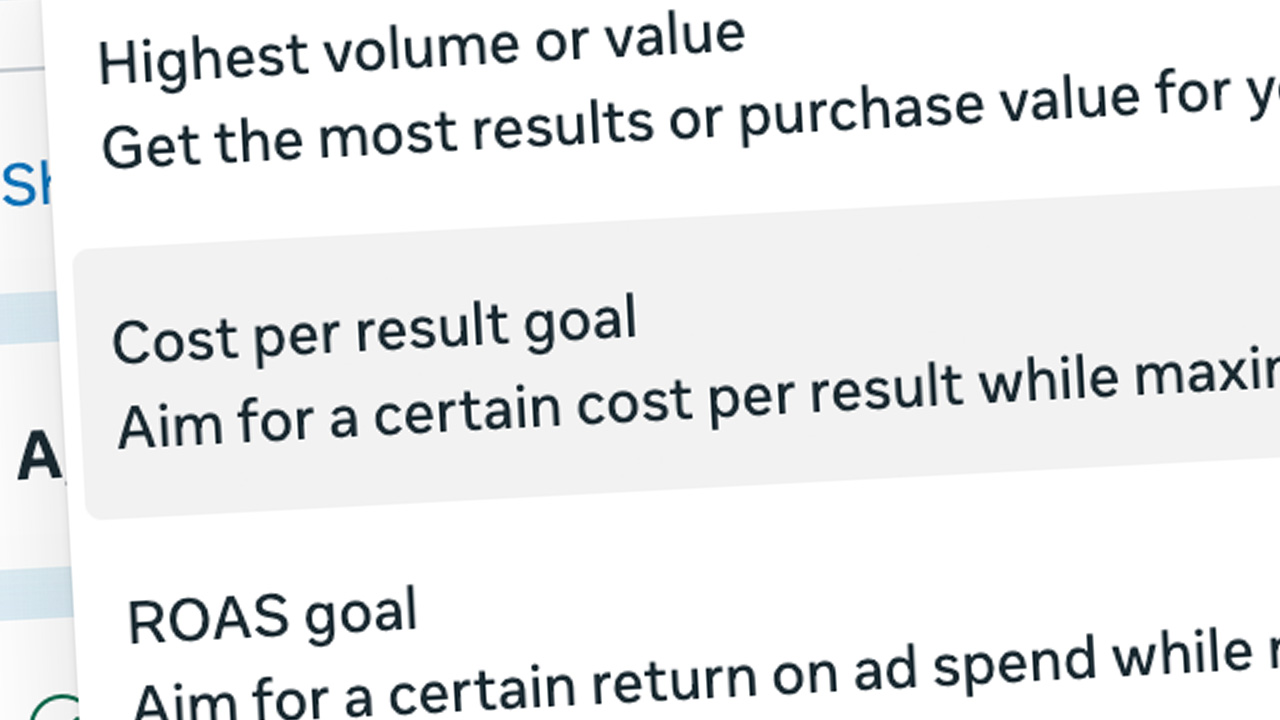
Technically speaking, a ‘Cost Cap’ is just a ‘Cost per result goal’ bid strategy that you set at the campaign level when you make a new campaign. This differentiates it from a standard Highest volume or value because it won’t chase spend for the sake of spend, necessarily.

That means that you if you try to spend, for example, $100,000 a day through a Cost Cap campaign (which is a CIBS build, really, but we’ll get to that) then it will only do so if it believes it can deliver results at your target CPA*.
*on a standard attribution window. We’ll talk about this later.
Once you’ve selected this bid strategy, you’ve made your first Cost Cap campaign. Congrats, pretty simple. But you’ve got some homework to do first.
What Should My Cost Per Result Goal Be?
While this varies for every business, your Cost Per Result Goal should be grounded in real data. Cost Caps work best when you have strong data that means your Cost Cap campaigns can leave learning quickly rather than struggling to push through unrealistically cheap conversions.
For my clients, I like to have Cost Per Result Goals set at 10% less than our New Customer Acquisition Cost (nCAC) for the last 30 days.
If your nCAC is $30 for the last 30 days, for example, then I’d start my Cost Cap campaign with a Cost Per Result Goal of $27. You set this as the ad set level here rather than at the campaign level.

When Should I Use Cost Caps?
They are not a one-size-fits-all solution because they need strong data signals.
If your campaigns struggle to get out of learning — or if you don’t know what this means — don’t worry about Cost Caps for now.
But if your business is growing, your ads are managing to hold higher budgets as you scale, and your Shopify revenue is looking good, then Cost Caps could be your next big unlock.
Are Cost Caps & Bid Caps The Same?
No.
Cost Caps derive their target from the end action — a Purchase, a Lead, whatever you’ve defined as your campaign’s target action. Your CPA target is based on data that you, the advertiser, know and have available. They’re basically just fishing for the ad impressions that will statistically deliver the action you want at the price you set by the end of your attribution window.
Bid Caps operate by adjusting a hidden number inside the structure of an ad reaching an impression in the first place: your actual bid for that impression. They’re theoretically safer because they’re even more reluctant to spend than Cost Caps and you can pull incredible efficiency out of them too. I tend to see them running really high Frequencies for basically this reason.
Find out more about how the Meta ad auction works through here.
I also wouldn’t encourage you to go about setting your own Bid Cap numbers because there’s no public visibility on your bid without your Meta rep fetching it via their internal tooling. Talk to them for more information about this process if you want to explore Bid Caps as a slightly safer, more heavily retargeted, higher Frequency Cost Cap intermediary.
How To Set Up Cost Caps
Cost Cap campaigns are actually quite easy to set up, technically. There are a few best practices to make sure you get the efficiency for which this bid strategy is famous so let’s go through them together.
Note first: there are two ways to set up a Cost Per Result Goal campaign.
Let’s go through them both together.
Note second: I’ll go through which ads to run in these campaigns later.
How To Set Up A ‘Standard Budget’ Cost Per Result Goal Cost Cap Campaign
The most straightforward way to test whether Cost Caps are right for you is to experiment with using a ‘standard’ budget. If you’re looking to test a Cost Cap campaign this way, I’d suggest starting with a 20% increase to your daily budget from yesterday (assuming yesterday was a good day).
Follow these steps:
- Create a new campaign with Cost per result goal as the bid strategy.
- Set your budget at the campaign level. A good rule of thumb is to set this at 20% of yesterday’s budget. eg. $200 per day if your budget yesterday was $1,000; $400 if it was $2,000, etc.
- Define your Target cost per result inside your ad set. Set this at 90% of your nCAC for the last 30 days. eg. $27 target cost per result if your nCAC for the last 30 days is $30.
How To Set Up A Cost Inflated Bid Strategy (CIBS) Cost Per Result Goal Cost Cap Campaign
If you talk to your Meta rep about wanting to run Cost Caps, they’ll likely come back to you talking about CIBS.
That’s because this is where Cost Cap campaigns really shine. But it’s also where they get really risky.
After all: if you can run a standard budget Cost Cap campaign and get great results, imagine what would happen if you could theoretically spend $1,000,000 a day for those same results…
That’s what CIBS campaigns enable. But there are a few things to clarify first.
What Do You Mean ‘Cost Inflated’?
Basically what it says on the tin.
Instead of setting your daily budget to a modest 20% increase on yesterday’s budget, you set your budget to $100,000, $500,000, or even $1,000,000 a day. This isn’t to say that Meta will spend that much given the chance — though I have seen them go absolutely ballistic in the ballpark of like $25,000 before 9am… — but they will try to.
How Do I Make Sure My CIBS Campaign Doesn’t Blow Out?
Even though we’re setting campaign budgets not ad set budgets, we can still set ad set spending limits at the ad set level to make sure we’re controlling investment in periods where it could get quite choppy. This is especially useful for when we’re just getting started but it’s also quite useful in super frothy periods like Black Friday when we’re launching a lot of fresh creative, a fresh offer, and taking advantage of massive demand.

To set an ad set spending limit, in the Budget & Schedule section of your ad set setup, expand the Ad set spending limits field, tick the ‘Set a minimum or maximum spend limit for this ad set’, and assign it to a $ value NOT a % value.
Set this maximum $ value to whatever you’re comfortable running as a test.
If you want to set this campaign up and monitor just once a day for seven days, give it a similar budget to a ‘standard’ campaign budget. If you want to keep an eye on it throughout the day, give it a slightly smaller number and be prepared to just increase this maximum spend as required.
You can also try to force a minimum spend if you want to get guaranteed investment through but this kind of clashes with the bid strategy. Minimum spends are much more useful for Highest volume campaigns where you want a baseline spend through ad sets in what would otherwise be a CBO (Campaign Budget Optimisation) campaign.
What If I Select A % Value Instead?
This is only really useful in the event that you’ve got multiple ad sets inside your campaign that you want to make sure get throughput. This method is less reliable with a Cost Cap than with a Highest Volume campaign just because of how those budgets are apportioned and spent but you can try it if you have a rationale. Just try not to overthink this stuff tbh. Simple is often scaleable.
Okay, I’ve Set Up My CIBS Campaign With An Inflated Budget, My Cost Per Result Target & An Ad Set Spending Limit. Now What?
Duplicate in your ads!
Which Ads Should I Run In My Cost Cap Campaigns?
Your best ones.
In theory, you could run every ad if you can fit them all in. Meta’s algorithm treats each ad as its own discreet unit so a Cost Cap campaign that spends tens of thousands a day on one ad won’t necessarily spend anything at all on other ads if it doesn’t think it will convert.
However: what we’re chasing here is efficiency and scale. We want throughput at a good price that leaves profit left over for the business. That means that your best bet will be to focus on the ads that are already working.
For now, duplicate in your best performing ads over the last 30 days at a minimum and even stretch back to the last 90 days for anything that’s not particularly seasonal (eg. don’t run Black Friday ads in April, even if you have a similar offer).
Remember that the function of a Cost Cap is to create scale with a cap so that you don’t risk blowing out. Give it the best chance to succeed with your best ads. Once it’s working and has been working for a while, then you can start getting creative with what ads go where.
I know some brands, for example, do all of their creative testing in a Cost Cap because it’s even more ruthless than highest volume. But that’s for later. That’s for when you’re comfortable with your Cost Caps.
My Ads Are In. My Budgets Are Set. I Am Ready. What Now?
Publish your draft campaigns, ad sets, and ads. Let them process, then sit back and… well, monitor, relax, get anxious, whatever it is you usually do when you experiment with your ads.
“But Zac,” you’re ask, “what do I do once they’re spending?”
Great question. The answer all depends on how performance looks.
My Cost Caps Didn’t Spend. What Do I Do?
Adjust your Cost per result target on your ad sets upwards. If they spent nothing at all, adjust it upwards by $5 or similar.
If they spent a bit but not a lot, adjust by $2.50.
My Cost Caps Are Working Well. I Want To Scale Them. What Do I Do?
You have three main levers to increase the throughput on a Cost Cap campaign:
- Adjust your Cost per result target upwards by $1 or $2. Don’t go too crazy because if you’re otherwise in a sweet spot, you’ll instead start feeding the ad algorithm inaccurate information about your expectations.
Note: single digit changes are more significant than they seem. There’s commentary online about adjusting Cost per result targets by $5 or $10 at a time but personally that’s just too variable unless you are going to be monitoring really aggressively (like, half-hourly or hourly at worst). - Adjust your campaign budget up.
If you’re running a ‘standard’ budget, scale it by 20%. Do this until it breaks.
If you’re running a CIBS budget, add another $100,000 to your campaign budget. This basically increases the surface tension Meta’s allowed to explore with the Cost Cap algorithm such that, while doubling your CIBS budget from $100k to $200k won’t double your conversions necessarily, it does give the algorithm permission to chase more aggressive auctions. - The answer to basically every problem that exists for Meta advertisers: launch new ads.
My Cost Caps Overspent. What Do I Do?
Conversely: Lower your Cost per result target by $1 or $2, depending on how far off your CPA target you are.
Note though that because these campaigns are still optimising for a 7-day click attribution window by default they might look really gross for day one or two before stabilising. This is what your ad set spending limits are for.
To really see how a fresh Cost Cap campaign is performing relative to the rest of your ads, check your 1-day click attribution window. To do this, click on Columns at the top of your Ads Manager table, then click Compare attribution settings. Then select the 1-day click box and Apply.


Compare your Cost Cap campaign 1-day click CPA to your other campaigns’ CPAs for a relatively clean reference for a fresh campaign.
Will My Cost Cap Campaigns Be Perfectly Reliable?
NO.
They are inherently risky. I’ve seen them break quite badly (cough: Saturday November 29th, 2025) and spend way too much.
Are Cost Cap Campaigns Worth It?
YES.
They have their risks and their challenges but:
When they work they really, really work.